Monday, February 18, 2013

"The Thing Itself" by Alethea Black


I Knew You'd Be Lovely
A: Alethea Black
S: “The Thing Itself”
B: I Knew You’d Be Lovely, Broadway Paperbacks, 2011
T: foreshadowing

“Foreshadowing” is a somewhat mystical storytelling device.  It’s hard to distinguish from an organic series of events.  This mysticism is implicit in the name: the shadow of things to come.  So I don’t find it surprising that the driving premise behind Black’s story, “The Thing Itself,” that plays so happily with foreshadowing, is somewhat mystical: the main character can sense things happening before they do.  The tension in the story arises when the main character senses something life-changing about to happen.  Both the main character and we readers are on tenterhooks waiting for the axe to fall.  Towards the end of the story, when everything is going pretty well for the protagonist, he walks home drunk.  I groaned while reading: he’ll be hit by a car.  Then I turned the page and read, “Then it hit him” (84).  But it was an idea, not a car.  On that walk home he gets hit by a Pepsi bottle, people wave at him and yell at him (warning him?), he stares obliviously around at the moon while things “whizz” by.  In other words: everything points to him getting hit by a car, that’s where the shadow falls.  As readers we also expect this because so many works follow a rule of hitting characters at their highest and saving them at their lowest.  Spoiler (seriously, if you don’t want to know the ending, stop reading now): then Black surprises us by defying expectations and letting the shadow fall elsewhere.    

Sunday, February 10, 2013

Stories within Stories: Zadie Smith and Kyle Minor


TS. “The Embassy of Cambodia” by Zadie Smith, found in New Yorker, Feb. 11 & 18, 2013

TS. “Seven Stories about Kenel of Koulรจv-Ville” by Kyle Minor, found in The Iowa Review,  Vol. 42, No. 3, Winter 2012/13

Both of these stories employ numbers to break up the narrative sequence.  In Smith’s case, it allows for a series of disconnected brief scenes.  Settings, characters, and images repeat, so it’s not as though the scenes are entirely disconnected, but rather the “flow” of the plot and conventional development of tension is replaced by repetition with difference.  In fact, if anything, this method allows for more connection than a conventional narrative, rather than less.  For Minor, as the title implies, the seven stories are seven stories, which means that seven “short shorts” involving the same characters, settings, tone, and some shared imagery, combine together to create the one complete short story—though in Minor’s case the seven sections are themselves clearly stories with the basic beginnings, middles, and ends.      

Sunday, February 3, 2013

2 kinds of weird: "Flesh & Blood" by Helen Phillips and "Reeling for the Empire" by Karen Russell


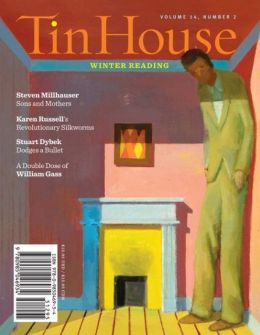
Tin House: Winter Reading2 kinds of weird. 

S&A: “Flesh & Blood” by Helen Phillips

S&A: “Reeling for the Empire” by Karen Russell


Reading these stories in the same journal made me reflect on the different types of “weird” (AKA, slipstream, magical realism, absurdist, fabulist, fantastical) story-telling styles. 

Helen Phillips’s story starts with a concept and then runs with it.  There’s no real plot, no character development, or conflict—just one person dealing with new, bizarre circumstances.  It feels rather like an exercise to me, rather than a finished story.  In Helen’s piece, the main character cannot see flesh, just everything under it.  It’s treated so literally, without any extraordinary circumstances, so it never seems like a symbolic or allegorical situation, just the exploration of a “what if”.

The conceptual framework of Russell’s story is every bit as bizarre as Phillips’s, if not more so.  Young women emit silk through their bodies and die if it’s not released.  Some factory owner capitalizes on it.  The color of the silk, the pain/pleasure of releasing it, the labor conditions and recruitment situations, and the development of characters beyond the protagonist, along with multiple layers of conflict (internal, between co-workers, against the boss), make this story at once highly symbolic, highly fantastical, and largely plot-driven.  Like Phillips’s story, “Reeling for the Empire” has a cool, unusual concept, but unlike her story the concept is balanced out by the features of story-telling one would expect from a realist piece (in sum: character-driven plot).

Saturday, January 26, 2013

"Virginia City" by Claire Vaye Watkins


T: “Virginia City”
A: Clarie Vaye Watkins
B: Battleborn, 2012

“Virginia City” does a lot that I want to do, including make a reader gasp out loud at the last sentence while reading on a fully packed subway.  Towards the end of the story (4/5ths through), the first person narrator leaves the particulars of her story for what sound like some generalities (I’m sure there’s a name for this narrative tone… anyone?): “There are plenty of good reasons to find yourself in Virginia City” (258).  In the next sentence the narrator goes immediately back into the context of the story with a flashback: “The first time we came, we came because Jules wanted to stand in the spot where Mark Twain stood.”  This paragraph more or less initiates the final, climatic scene of the main plot, in which the conflict between the characters explodes and all is lost (page 261). 

In the resolution after the climax, Watkins repeats the phrase at the start of the penultimate paragraph: “There are plenty of good reasons to find yourself in Virginia City, if you need one” (262).  It’s a brilliant move, because 1. it relieves some of the tension of the dramatic climax, 2. it makes the sense of change palatable—the phrase does not feel the same after the drama has unfolded, and 3. it alerts the reader that something poignant is coming, something you should pay attention to because this might just be the point, that we’ve entered the realm of poetry, so watch out.  In a subtle story, and what good stories aren’t subtle, such signposts are tricky and welcome.  This time the narrator lingers in the realm of the general for a few sentences then concludes with this beautiful iteration of the theme: “There are plenty of good reasons to find yourself in Virginia City, but there’s only one reason.  We came to time-travel.” I love the way that second sentence (“We came to time travel”) is both personal and character-specific (Jules, for example) and, in the context of the paragraph, general enough to apply to anyone (any tourist who wants to stand where Mark Twain stood).  (Also, this is the first explicit mention of “time-travel” and it’s at once completely a shock and completely perfect for the context—at once inevitable and unguessable.) 

Sunday, January 20, 2013

"If I Loved You" by Robin Black and (briefly) "The Last Thing We Need" by Claire Vaye Watkins


T: “The Last Thing We Need”
A: Clarie Vaye Watkins
B: Battleborn, 2012

T: “If I Loved You”
A: Robin Black
B: If I Loved You, I Would Tell You This, 2010

Q: How do these writers use the epistolary form successfully?

Background: Recently a friend I workshop and write exercises with has been composing an epistolary short story.  It’s a form I’m not inclined towards, but his efforts have piqued my interest.  Because his story is one neighbor writing to another, I’ve been reminded of Robin Black’s beautiful short story “If I Loved You” a number of times.  Watkin’s short story, “The Last Thing We Need,” is also an epistolary short story and, like my friend’s piece and Robin Black’s, is written from only one side of the epistolary exchange (in other words, we only see one side of the letter writing, no letters are exchanged).     

A: Robin Black’s story is key—as the title suggests, her narrator doesn’t mail the letter, doesn’t even write one (in other words, I remembered wrongly) so it becomes a 2nd person narrative without the awkwardness of a second person narrative.  That awkwardness stems from the ambiguity of the “you”—generally we might think it’s the reader or, when done expertly, the narrator herself.  However, the way both Black and Watkins use the form, the “you” is a clearly defined person, a silent listener, who is also a character in the piece without becoming a generic category.